
At the intersection, I could go right and head home — but turning left would take me…
Why on this world would I want to head home? There is nothing, or anyone, there for me anymore. Even the dog has gone to who knows where. The house, once full of life and love, has been deserted—not by choice but by happenstance—ever since the great event that took the last occupant. The echo of laughter in the empty hallway fades each evening, replaced by the hum of silence. The house, like all the others, is covered with a red mask disguising its face.
The red dust settles on everything, disguising what once was. I brush it from the porch rail, but it clings stubbornly, just as my sorrow clings to the edges of memory. The silence in these empty rooms echoes the hollowness inside me. Yet as I stand at the crossroads, the ruined world behind me, I feel a flicker of something stubborn—a hope that somewhere, beyond the decay, life endures. As the house crumbles, so do the pieces of my old life…
Scenes of children playing in the quiet streets beneath the canopy of tree limbs have long faded into distant memories. Their laughter is no longer heard as it once wafted on gentle breezes. Trees are bare of leaves and fruit, leaving nothing but the bleached remains.
I don’t know why I remain—the last of them with no one to share the events of the day. Our extended, generational family shared cool evenings on the porch, telling stories of long ago or the day’s moments. They, too, have gone the way of all the others who didn’t leave in time. They live only in my memories.
My dog, funny-looking old fellow with short, golden hair and ears which pointed in different directions—his left one always flopped downward. His big brown eyes would look up at me as he tried to communicate his desire to go for a run in the park, or his hope that it was time for his cookie. One morning, after finishing his early snack, he went outside and never returned. I searched for hours, then days, but finally gave up hope of ever seeing him again.
But here I am, at a crossroads. Do I go to the right, the direction I have taken throughout most of my life? The direction where only memories reside? Or should I turn left to the great unknown?
To the great beyond, where no one has dared to go for as long as I can remember? What is out there? What can be out there? In school, we were taught the universe is vast and there must be life in the great beyond. We should never be so conceited as to believe we are the only life form.
Perhaps others like me are trying to escape loneliness and lack of purpose, or running to hide from a dying world?
My bags are packed, and I have enough food, the last of the food supply, for a long journey into the alien abyss, so why question my decision any longer?
The parched earth, the relentless heat of the twin suns, the sound of storms battering empty fields, and the sight of forests reduced to stumps is too much to bear. The soil is dry and cracked, or flooded and washed away. Funnels of spinning wind are numerous, and in other areas, the oceans rise, taking over, and the land is submerged, swallowing homes and people.
The world is starved of the necessities for life. Livestock have died. Crops have dried up, and food that had been stored in massive warehouses is also gone. Along with the crops, rivers have dried up while oceans rise.
Our once glorious and fruitful world remains only a memory. As the last of us fade away, even the memory will disappear.
Scientists tried to warn the population decades ago that changes must be made to save our world. But men full of greed and hubris laughed and convinced the people that science was wrong. It was too late by the time the righteous were believed. That was when the super wealthy boarded their spaceships for greener lands.
A few, however, didn’t get far as their ships exploded upon takeoff. Men who once claimed science was wrong now relied upon it to save them.
Some of us, a part of the scientific community, knew we had to do something and began to build small ships that could carry a few people to an awaiting mothership to rescue as many people as possible.
My small airship is among the last to depart for distant shores. In my pocket, I carry small remnants of my past. A pebble from the garden where my mother taught me to plant seeds and grow food. A small piece of her hair braided into a tiny ring shape, which I can wear when I need to be with her. And one image of my loved ones in a strong frame, to keep them safe.
With the final decision made, I will turn to the left and alter my heading to the furthest star on my sky map. In time, I hope I will find life out there. Somewhere in the darkness of space, we have been told there is another world with clean air and water, and people who resemble us, who, unlike us, have not destroyed their home planet.
For a moment, I imagine standing on the porch, remembering the laughter which once filled these streets, the music of festivals, the warmth of family gathered close. I take a deep breath, tasting the dry air, and look up at the sky, where the twin suns burn through a haze of red.
As I board my small airship, I glance back one last time. The house stands silent, a monument to all that has been lost. I clutch my keepsakes tightly—a pebble, a braid of hair, a photograph—tokens of a world that is now only memory. The engines come to life with a vibration I feel more than hear, and as I rise above the ruins, I whisper a silent goodbye.
I turn left. The world falls away beneath me, and the sky opens into the endless dark.
From the small airship’s cockpit, the vastness of space unfolds in breathtaking clarity. Ahead, dozens of other small airships drift gently, their lights twinkling like fireflies gathering for a silent rendezvous. They cluster together, reminiscent of cars assembling at a drive-in theater, engines humming softly in the void.
Beyond them looms the massive mothership, a colossal silhouette against the infinite black canvas, its surface dotted with glowing windows and pulsating lights. The distant stars sprinkle the darkness like scattered diamonds, cold and eternal, as the fleet slowly converges toward hope and survival.
As I guided my small airship closer, the mothership‘s true scale became overwhelming. The drawings and images we’d watched change and develop over the years of its construction couldn’t compare to the reality before me. It was more impressive than anyone’s imagination could have conceived. This would be our home for what might become a very long journey.
There were hundreds—no, thousands—of windows scattered across its massive shell. Colored lights—blue, red, yellow, and green—outlined its form, flickering on and off in random flashes. Sometimes, the lights danced in streams of mixed, alternating colors, reminding me of the fireworks that once lit up the night sky during celebrations.
For all its immense size, the mothership moved in absolute silence, gliding through the blackness so quietly it seemed almost unreal. Even as dozens of other airships approached, their engines left no trace of sound; only the shifting patterns of light marked our arrival.
Until all the smaller airships were safely onboard and every passenger accounted for, none of us would know how much of the remaining population had escaped the dying planet. I found myself scanning the ships, wondering who else had survived, and who I might never see again. As I looked out toward the farthest faint spot of light, I imagined if it was our destination. Our new home and fresh start. Carrying within us the lessons learned to protect our new home.
I remembered the luxury airships that had departed first—sleek vessels plated in gold, built for comfort and spectacle rather than survival. Their propulsion systems, powered by magnetic sails and advanced plasma drives, were marketed as the safest ever devised: no volatile fuels, no risk of explosion, just silent, clean thrust harnessing the energy of the stars themselves.
But even the best technology couldn’t compensate for vanity. As those ships accelerated toward the edge of the atmosphere, the heat and stress proved too much for their ornate hulls. The gold plating, so dazzling in the shipyards, melted and peeled away under the relentless friction and radiation, exposing the fragile superstructure beneath.
One by one, we watched in horror as several of those luxury liners failed catastrophically—their hulls buckling, their lights winking out, leaving only a brief, silent flare against the darkness.
For all their promises of safety, the ships designed for profit and prestige became tombs drifting in orbit—a stark warning that no amount of wealth could shield anyone from the laws of physics or the consequences of hubris.
The autopilot maneuvered the airship toward the docking area of the mothership as we took our place in line. A voice originating from the dock area welcomed us aboard and provided instructions for our next step after we disembarked. The animated voice sounded as human as any of us.
“Welcome to Coeptum,” the disembodied voice announced.
For the first time since my journey began, my heart raced with anticipation. Decades of planning had brought me here, but now it all felt like a distant dream.
“Time to see what’s next,” I said softly, reaching for my bags. Two worn satchels held everything I owned: a few books, pens, notebooks, and enough clothing for several changes. Not much to begin a new life—but I’d started with less before.
At last, we were aboard our new home, and as the airships were moved into their storage compartments, the survivors gathered, ready to explore the mothership. Before them, a massive metal door opened, revealing the shining, flying city.
As I stepped from the airlock into the vast, echoing corridor, my eyes caught a gleam of polished metal. A plaque was mounted beside the entrance, its inscription crisp and deliberate:
Welcome to Coeptum (Enterprise)
Boldly we go
The words lingered in my mind as I moved forward, reminding me this was more than escape—it was the start of something new, for all of us.
Unlike any city on the surface, this metropolis gleamed with new metal. The roadways were designed for walking, not driving, and the pavement was tiled—or made of something resembling tile. Doors and large windows lined the streets, reminiscent of old shopping centers.
Above it all, the ceiling arched high overhead, transformed by the ship’s Virtual Horizon. Where one might expect cold metal, there was instead a vast expanse of simulated sky—soft morning light spilling through drifting clouds, the illusion so complete that for a moment, I almost believed we’d stepped outside. The gentle warmth and shifting light eased the tension in the crowd, inviting us to look up and imagine possibilities beyond survival.
Our guide explained that the colorful lines on the floor would help us find our way and keep us from getting lost. The color showed the way, and written on the line were the destinations.
“As long as you follow the guidelines, you won’t get lost. You are free to explore the ship, it’s your home now. Any of the crew will be happy to answer your questions as you find your way. If you should require help with anything, they can either assist you or direct you to the proper person or place.”
I remembered a time, years ago, when I wandered a hospital’s endless corridors, following colored lines without realizing what they meant. It took a while to figure it out, too. At least here, someone was kind enough to explain.
The green lines led to the Arboretum, a manufactured green space offered a semblance of normalcy. Here, gardeners inside a massive greenhouse grew and stored our food. There were trees, bushes, flowers, and even a lake. Overhead, special lighting mimicked day and night, while an intricate system could summon rain—or, at the touch of a button, transform a sunny day into a torrential thunderstorm.
I marveled at how thoroughly the builders and scientists had prepared for this new life.
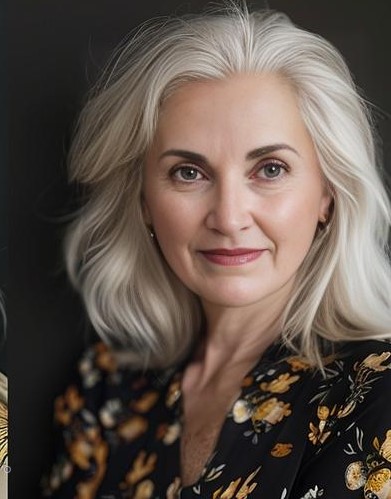
We continued following our guide, who led us to our cabins, our new homes during the journey. As we walked down the corridor, a woman about my age glanced over, her eyes tired but alert.
“First time on a ship this size?” she asked, managing a small smile.
I nodded. “I still can’t believe we made it.”
She held up her battered satchel. “All that’s left of home, right here.”
I held up two satchels in agreement.
“Do you know anyone on board?” I asked, careful not to pry but wondering if she, too, had lost loved ones.
Her eyes softened, drifting to the side as if searching for a memory. “No, no one.” Then she looked back at me and smiled. “But now, I know you.”
Our guide called my name and directed me to cabin C-1372. The code for cabins was deck C, cabin #1372. The cabin areas were arranged similarly to a hotel room number and locations, making it easier for us to find our way “home”.
I said goodbye to my new friend after making plans to meet for dinner on the concourse at 6 o’clock. A quick wave, and I entered my cabin.
My cabin—my home. It was small, after all, it was home to one person. It reminded me of a cruise ship I once sailed on. Small, windowless, with only the most important amenities. A tiny bathroom, single bed, side table with a small reading lamp, a desk or table for dining if desired, and a closet for my small wardrobe. It was perfect for me.
After a refreshing shower and a change of clothing, I surveyed the room.
“I can’t believe I made it this far.”
“Let’s check out the food.” And stepped into the hallway.
The small card I found on the desk in my cabin listed the guide line colors and where they led. After determining the path to the concourse, not knowing how long it would take to arrive, I started the walk into my future.
At the end of the yellow guideline line, the wide hallway opened to an immense concourse. Nothing on the planet could compare to this sight. The vaulted ceiling was at least three stories high, and along one wall was the biggest window I had ever seen. It spanned floor to ceiling and wall to wall providing a panoramic view of the universe. Tables serviced small groups of two or four people spanned the floor. Subdued lighting did not distract from the celestial view.
My new friend arrived while I was standing in awe at the entrance. Her gentle touch on my shoulder awakened me from my trance. The jolt caused me to make a small jump and turn to the source of my surprise. We laughed, shook our heads like old friends, and made our way to a small table with a clear view of the universe. We made small talk, as strangers will until they find their way, and then as we grew more comfortable, the conversation developed into more serious discussions.
We sat together at a small table near the vast window, the universe stretched endlessly beyond the glass. The soft hum of conversation and the gentle clink of tableware filled the air, but all I could focus on was the shimmering stars and swirling galaxies outside.
My new friend lifted her glass, filled with a pale, sparkling aperitif, and offered a quiet toast. “To the future,” she said softly.
I raised my glass, our eyes meeting for a moment of shared understanding.
“To the future,” I echoed, and our glasses touched with a gentle clink.
For a while, we sat in silence, letting the enormity of what we’d survived—and what we’d lost—settle between us. I thought of those who hadn’t made it, whose laughter and stories were now only memories. Their absence was felt in the quiet, in the space beside us at the table, in the endless night beyond the glass.
Yet here we were, survivors, together. The stars outside seemed to promise new beginnings, vast possibilities, and the hope that life, in some form, would endure.
As the light from distant suns danced across our faces, I felt a fragile hope take root—a hope that, despite all we’d lost, we could build something new.
The stars stretched endlessly beyond the glass, and for the first time in a long while, hope felt real.

 Call Me Kat
Leave a comment